





Copyright © SUNGROW 2023. All Rights Reserved 皖ICP备2022012337号-3

TEL
+86 - 0551 - 6532 7879
Copyright © SUNGROW 2023. All Rights Reserved 皖ICP备2022012337号-3




2024.12.27
178
On December 27, Hefei hosted the successful kick-off meeting for the "Wind Load Calculation and Testing Methods for Floating Photovoltaic Power Generation Systems" standard. The standard is spearheaded by Sungrow FPV and administered by the National Technical Committee for Standardization of Solar PV Energy Systems (SAC/TC90). The meeting brought together 32 industry experts from 19 co-compiling organizations. As the first standard of its kind in the floating PV sector, it will offer a scientific foundation and technical reference for product structural design, comprehensive environmental load assessment, and anchoring system development.
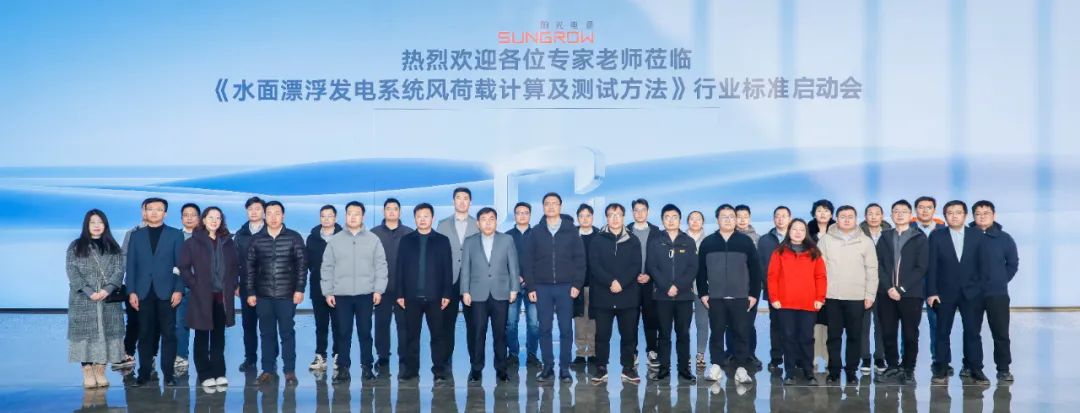
Dr. Wu Weiwu, Chief Technology Officer of Sungrow FPV, gave the opening address on behalf of the lead compiler of the standard. He emphasized that wind-resistant design is a critical factor for the safe and reliable operation of floating PV systems, and that improving system safety and reliability remains a core focus of Sungrow FPV's ongoing R&D efforts. The development of this industry standard represents a thoughtful interpretation of the sector's developmental needs and will promote healthy industry growth. It also underscores our commitment to both society and our customers, while reinforcing our dedication to excellence in product and system design quality and service delivery.
The forthcoming standard "Wind Load Calculation and Testing Methods for Floating Photovoltaic Power Generation Systems" aims to define the fundamental parameters and methodologies for wind load assessment, including the calculation approaches and formulas for basic wind pressure, pressure coefficients, height variation factors, and array-area coefficients. Precise wind load evaluation is essential for the structural design and optimization of floating PV systems, striking the right balance between structural integrity and cost-effectiveness.
Experts at the meeting conducted comprehensive deliberations on the draft standard, establishing a clear direction for the standard's development, defining its core technical elements, and mapping out the next steps—setting a strong groundwork for the work ahead. Going forward, Sungrow FPV will work closely with all co-compiling entities to drive the standard's formulation and adoption. With a commitment to scientific rigor and practicality, we will take full account of the industry's current conditions and future needs, ensuring that the standard is robust, rational, and actionable. Together, we are dedicated to fostering the healthy and sustainable development of the floating PV industry.
TEL