





Copyright © SUNGROW 2023. All Rights Reserved 皖ICP备2022012337号-3

TEL
+86 - 0551 - 6532 7879
Copyright © SUNGROW 2023. All Rights Reserved 皖ICP备2022012337号-3




2021.10.28
150
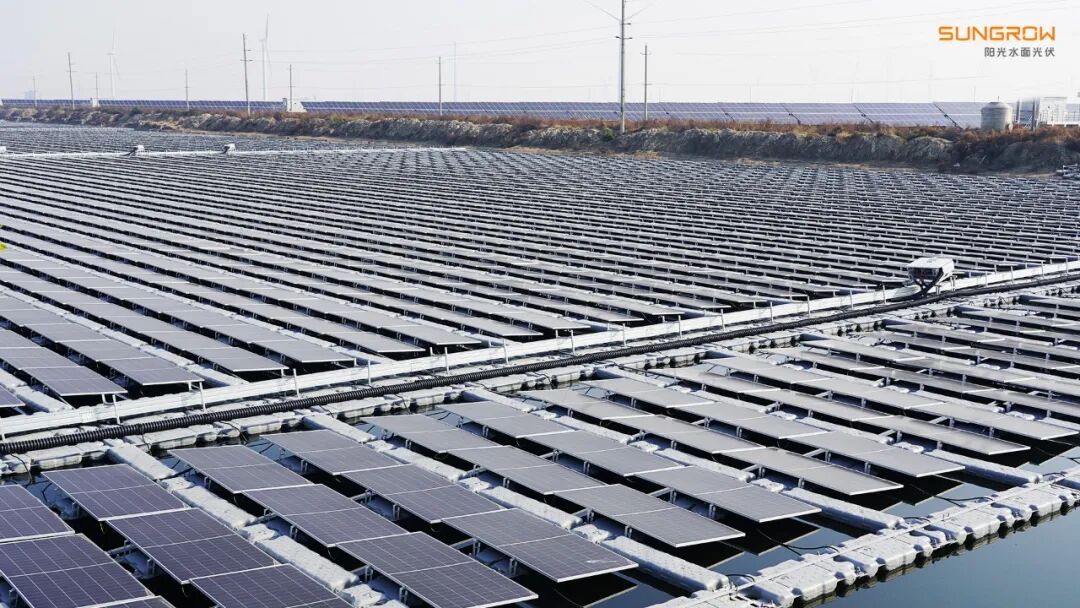
On the northern bank of the vast Huaihe River, over a coal mining subsidence lake in the Nihe area of Panji, Huainan, 16 floating PV arrays made up of 160,000 solar modules are neatly arranged alongside more than 1,000 aquaculture cages. The integration of solar power generation and fish farming is composing a new "fishery-solar symphony" of green transformation and ecological well-being for the new era.
Complementarity of Fishing and Solar Power Yields High Ecological and Economic Gains
The 40 MW fishery-PV complementary floating power station in Panji, Huainan, is located in a coal mining subsidence area, with a total water area of over 6,000 mu (approximately 400 hectares), of which the floating PV section occupies more than 1,300 mu (around 86.7 hectares). As the world's first large-scale floating PV plant, it adopts a fishery-PV complementary development model and was connected to the grid in 2016.
Since the beginning of this year, provinces and cities including Guangdong, Shandong, Fujian, Shanghai, and Gansu have successively released their 14th Five-Year Plans, encouraging the adoption of models such as fishery-PV complementarity and the development of "PV+" power plants tailored to local conditions. Floating PV approaches like fishery-PV complementarity will continue to serve as an important part of China's photovoltaic industry, helping to resolve the conflict between PV development and land use, while contributing to the achievement of the "dual carbon" goals.
Floating PV plants can improve water quality and provide a favorable growth environment for fish. The shading effect of floating PV arrays helps reduce water evaporation losses, inhibit algae growth, and prevent eutrophication. TÜV SÜD conducted water quality tests on the Panji plant in accordance with the EU Surface Water Standard, the EU Drinking Water Directive, and the WHO Drinking Water Quality Guidelines. The test results showed that all 36 tested parameters—including total phosphorus, nitrate, and chemical oxygen demand (COD)—met the required standards. Notably, indicators such as COD (used to assess organic pollution) showed better results compared to a reference water body without a floating PV plant.
Cost Comparison of Pile Foundations vs. Floating Systems at Different Water Depths
In addition to maximizing the utilization of water resources and its applicability across various scenarios, floating fishery-PV complementary systems also offer certain cost advantages over pile-based systems. A pile-based plant typically adopts a standard 2×28 layout as its basic unit, with each unit requiring 8 piles. Based on the latest market data, the cost of pile foundations and supports can be estimated for different water depths and pile lengths. Calculations show that at a water depth of 3.5 meters, the foundation and support costs of a pile-based plant are roughly equivalent to the floating system (including anchoring) of a floating PV plant. As water depth increases, the cost of pile-based systems rises more significantly, while floating systems become increasingly cost-competitive. Beyond material costs, floating systems also offer faster installation, require no heavy machinery, and reduce construction costs by approximately 30%. Additionally, floating systems are easier to maintain, offer better water surface cleanliness, and provide clear advantages in annual O&M costs.
New "Floating" Cage Aquaculture Technology
To fully leverage the advantages of fishery-PV complementarity, Sungrow FPV has developed a new "floating" cage aquaculture technology, creating a cage structure and fishery-PV integration device that integrates with existing floating PV systems. The cage structure consists of fishing nets and multiple movable components, and is connected to the parallel connecting beams already present in the floating PV array, with buoyancy provided by the floating array itself. The cage can slide along the extension direction of the connecting beams, facilitating feeding and harvesting without the need to raise the PV modules to achieve fishery-PV coexistence. This solution can be flexibly adapted to various water environments, with the optimal floating PV system solution tailored to specific conditions such as water depth, wave height, underwater terrain, and fish species.
The cage aquaculture under the PV panels is primarily focused on shade-loving fish species. Taking the yellow catfish (Pelteobagrus fulvidraco) as an example, each cage measures 7,600 × 4,560 × 2,500 mm. According to the layout plan, 18 cages occupy approximately 2.3 mu (about 1,533 square meters) of water area and can be managed by a single worker. With a 12-month farming cycle, each square meter of cage can yield about 50 kg of yellow catfish. After factoring in equipment, labor, feed, medicine, electricity, and other costs, and assuming a five-year depreciation period for the cages, the annual profit per cage is estimated at around RMB 8,000. If there is spare water space adjacent to the PV area, it can be used to establish intensive raceway aquaculture with minimal footprint, with a single raceway generating annual profits of over RMB 100,000. By combining cage aquaculture with raceway systems under the fishery-PV model, overall returns can be significantly increased.
In recent years, the installed capacity of individual floating PV plants has continued to set new records, while their application scenarios have expanded from lakes, ponds, and industrial reservoirs to drinking water reservoirs, hydropower reservoirs, and even nearshore waters. Their advantages—including no land occupation, high power generation efficiency, easy construction, and convenient operation and maintenance—have been fully realized. They can also be integrated with pumped storage, aquaculture, and tourism, with new technologies emerging continuously. Expectations are high for floating PV to play an even greater role in achieving carbon neutrality and carbon peaking goals.
TEL